Farmers Knew How to Read the Land Like a Book — and Wilderness Schools Are Charging Good Money to Teach It Again
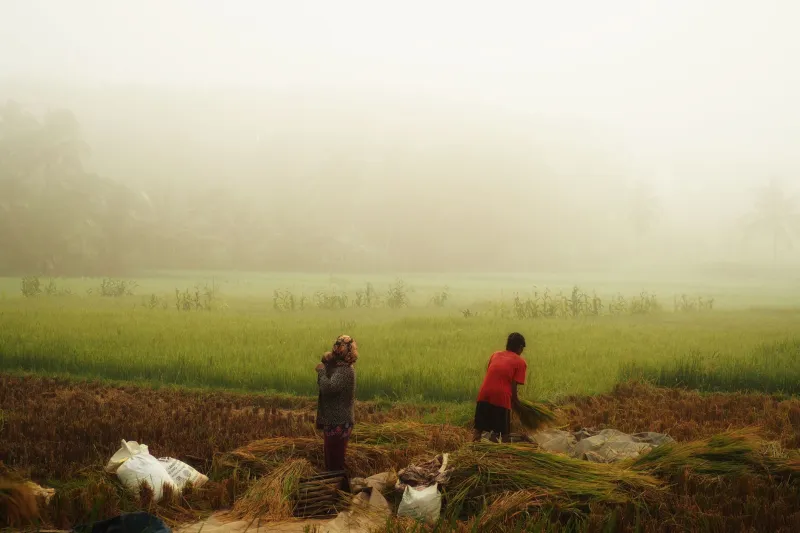
There's a moment in certain wilderness education courses where a student smells the air before a rainstorm and suddenly understands why their great-grandmother always knew when to bring in the hay. That smell — earthy, sharp, unmistakably pre-rain — has a name now. Scientists call it petrichor. But farmers in rural America were reading it as a reliable weather signal for centuries before anyone in a laboratory gave it a word.
That gap between what rural people knew and what formal science later confirmed turns out to be bigger than most people expect. And a growing number of outdoor educators are building entire curricula around recovering it.
Knowledge That Traveled Entirely by Mouth
The land-reading traditions that developed in American agricultural communities were never written down in any systematic way. They moved through families and neighborhoods orally — a grandfather showing a granddaughter how the behavior of creek water near a bend indicated recent upstream rainfall, a shepherd teaching an apprentice which hillside plants grew only where underground water ran close to the surface.
Much of it was hyperlocal. The signs that worked in the Ozarks didn't necessarily translate directly to the Cascades or the Appalachians. Farmers developed acute sensitivity to the specific landscape they inhabited, accumulating observational data over years in ways that would take a modern meteorologist considerably more equipment to replicate.
And then, over the course of roughly three generations spanning the mid-20th century, most of it disappeared. Mechanized agriculture reduced the need for the kind of intimate daily contact with land that generated and sustained this knowledge. Weather forecasting moved to radio and television. Younger generations left rural areas. The oral transmission chains broke.
What remained was mostly dismissed as folk superstition — the kind of thing people cited with affectionate skepticism rather than genuine curiosity.
The Science That Was Hidden Inside the Folklore
Here's where it gets interesting. When researchers started examining traditional land-reading practices with modern scientific tools, they found that a surprising proportion of them had solid mechanistic explanations.
Take petrichor — that pre-rain smell. It comes primarily from a compound called geosmin released by soil bacteria as humidity rises, combined with plant oils released from dry ground. Human noses are extraordinarily sensitive to geosmin, capable of detecting it at concentrations of a few parts per trillion. Farmers who said they could "smell rain coming" weren't being poetic. They were accurately detecting a real biochemical signal, even if they had no vocabulary for what was producing it.
Or consider the old observation that certain plants "predict" rain by changing their orientation or the angle of their leaves. This turns out to be real plant physiology. Many species adjust leaf angle in response to changes in atmospheric humidity and light intensity — the same conditions that precede rainfall. Farmers who noticed that their clover was "lying down" or that certain wildflowers were closing weren't imagining things.
Animal behavior as weather prediction has a similarly solid scientific basis. Insects fly lower before storms because dropping air pressure makes it harder for them to maintain altitude — which is exactly why swallows and barn swallows dive low before rain, following their food source. The farmer who said "the swallows are flying low, rain's coming" was making an accurate inference from a real physical phenomenon.
Even the practice of reading creek behavior for navigation and water-finding has been validated. The way water pools and eddies around certain geological features reliably indicates the underlying rock and soil structure, which in turn predicts where springs are likely to emerge. Experienced rural travelers used this to find water in unfamiliar terrain with accuracy that seems almost uncanny until you understand the geology behind it.
What Wilderness Schools Are Teaching — and Who's Paying to Learn It
The revival of these skills is happening through a loose network of wilderness education programs, tracking schools, and foraging guides scattered across the country. Some of the better-known programs include the Wilderness Awareness School in Washington State, Tom Brown Jr.'s Tracker School in New Jersey, and numerous regional nature immersion programs that have proliferated over the past decade.
The curriculum varies, but the core thread is consistent: teaching students to read the landscape as an integrated system rather than a collection of isolated facts. Students learn to interpret soil color and texture for water content, to identify "indicator species" — plants that only grow under specific soil or moisture conditions — and to read topography for shelter, water, and navigation without instruments.
The student demographics are telling. These aren't primarily survivalists preparing for apocalyptic scenarios. They're hikers, backpackers, hunters, and outdoor enthusiasts who have realized that GPS tells you where you are but doesn't tell you anything about the land itself. There's also a growing contingent of farmers and homesteaders interested in recovering practical knowledge that applies directly to land management.
Weekend workshops run $200–$500. Immersive multi-day programs can cost considerably more. The demand, by most accounts, is growing.
Why It Turns Out to Be More Useful Than It Sounds
Beyond the practical applications, there's something else happening in these courses that instructors describe consistently: students develop a different relationship with the landscapes they move through.
Reading land requires sustained, attentive observation over time. You can't do it passively. You have to notice things — the way a particular hillside dries faster after rain, the plants that cluster around a seep spring, the subtle color shift in soil near a buried stream. That quality of attention, practiced regularly, changes how a place feels to the person paying it.
Farmers who carried this knowledge didn't just know where to find water or when to expect rain. They inhabited their landscapes in a way that most modern outdoor enthusiasts, for all their technical gear, genuinely don't.
That might be the most remarkable thing about this rediscovery: the knowledge itself is useful, but the practice of acquiring it turns out to be something people find genuinely irreplaceable.