The Neighborhood Drill Press Nobody Owned Alone — How Tool Libraries Once Held Communities Together
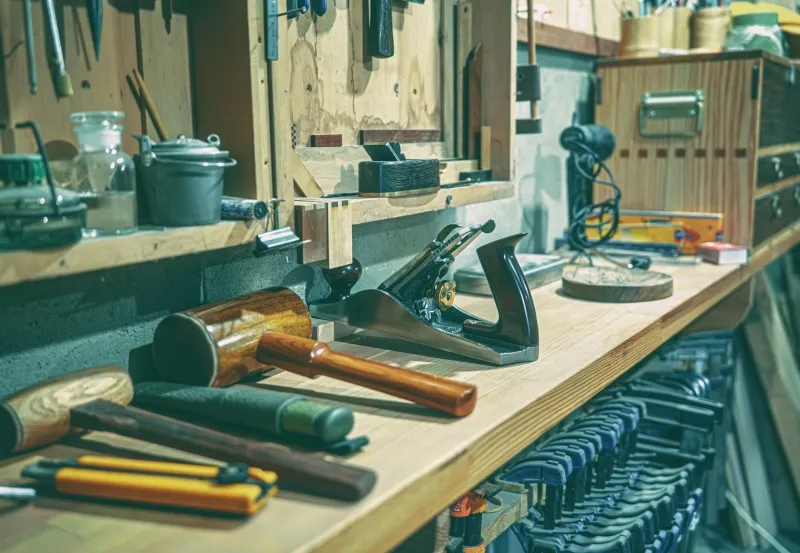
Somewhere in a garage near you, there is almost certainly a tool that hasn't been touched in two years. Maybe it's a circular saw bought for a single weekend project. Maybe it's a power washer that came out once, then got buried behind the holiday decorations. Americans collectively own billions of dollars' worth of equipment that sits idle for the vast majority of its existence — purchased, used briefly, forgotten.
For a good chunk of the 20th century, a different arrangement existed in many communities. It didn't have a catchy name. It wasn't a startup. It was just neighbors sharing tools, often through informal systems that worked remarkably well. And the fact that it faded away says a lot about how American life changed — and why some people are quietly trying to change it back.
How the Old System Actually Worked
The roots of community tool-sharing in America run through several different traditions that all pointed in the same direction.
In rural communities, equipment sharing was simply practical necessity. A threshing machine or a hay baler was too expensive for any single farm family to own outright, so neighbors pooled resources, shared the cost, and took turns using it. The arrangement was governed by informal social contracts — you borrowed in good faith, you returned in good condition, and you showed up to help when it was someone else's turn to need something.
In urban neighborhoods, particularly in immigrant communities in cities like Chicago, Pittsburgh, and New York, similar systems developed around household and workshop tools. Hardware stores sometimes functioned as informal lending hubs. Churches and civic organizations occasionally maintained small inventories of shared equipment. The underlying logic was the same: most people need a pipe wrench about twice in their lives. Owning one is wasteful. Sharing one makes sense.
Some towns formalized this into actual lending programs, particularly during the Great Depression and World War II, when resource conservation wasn't a philosophy — it was a survival strategy. The ethos of use it, return it, let the next person have a turn was simply how things worked when money was tight and community ties were strong.
What Killed It
The postwar economic boom did a number on communal resource-sharing in general, and tool-sharing specifically.
Suburban expansion scattered neighbors across larger lots with longer driveways and fewer natural gathering points. Rising incomes made individual ownership feel not just possible but desirable — a new drill was a marker of arrival, of having enough. Consumer culture, which grew into something enormous between 1950 and 1980, actively promoted the idea that owning your own was better than borrowing someone else's.
Hardware chains and big-box stores eventually made tools cheap enough that the economic argument for sharing weakened. Why coordinate with a neighbor when you could drive to Home Depot and buy a jigsaw for forty dollars? The transaction cost of borrowing — the social navigation, the scheduling, the obligation — started to feel higher than just buying your own.
Community tool-sharing didn't disappear all at once. It just gradually stopped being replaced when it broke down. By the 1990s, it had largely faded from American neighborhood life.
The Modern Tool Library Movement
The revival started modestly enough. The Berkeley Tool Lending Library, opened by the city in 1979, is often cited as the first modern American tool library — a genuine public institution where residents could check out equipment the way they'd check out a book. It's still operating today, and it still has a waiting list for popular items.
For decades, Berkeley's model was an outlier. Then something shifted. Starting in the late 2000s and accelerating through the 2010s, tool libraries began appearing in cities across the country — Portland, Cleveland, Pittsburgh, Minneapolis, Philadelphia, Denver. Some are run by municipalities. Others operate through public libraries, maker spaces, or community nonprofits. A few are entirely volunteer-powered, run out of donated warehouse space on the strength of neighborhood enthusiasm.
The West Philadelphia Tool Library, founded in 2010, became something of a model for the grassroots version. Members pay a modest annual fee, volunteer a few hours per year, and gain access to hundreds of tools they'd never be able to justify buying individually. A tile saw. A rotary hammer. A quality pipe threader. The stuff that you need exactly once for a specific project and never again.
What organizers consistently report is that the tools are almost beside the point. The real product is the conversation that happens when someone comes in to pick up a belt sander and ends up spending twenty minutes getting advice from a volunteer who's tiled three bathrooms. The skill-sharing that happens organically around the physical equipment.
Why It Matters Now
There's a practical argument for tool libraries that's easy to make. The average American household owns around $800 worth of tools and uses most of them fewer than a dozen times per year. The math on collective ownership is obvious.
But the more interesting argument is the social one. Urban planners and community researchers have spent years trying to understand why some neighborhoods feel cohesive and others don't, why some blocks generate mutual aid during crises while others remain strangers until something goes wrong. One consistent finding is that repeated low-stakes interactions — the kind that happen when you borrow a ladder or return a pipe wrench — build the relational infrastructure that makes genuine community possible.
Tool libraries create those interactions by design. They give neighbors a reason to show up, to talk, to owe each other small favors. That's not a side effect. For many of the people running these organizations, it's the whole point.
The drill press was always just the excuse.