The Grease-Stained Cards at Estate Sales Are the Most Honest Food History Nobody's Collecting
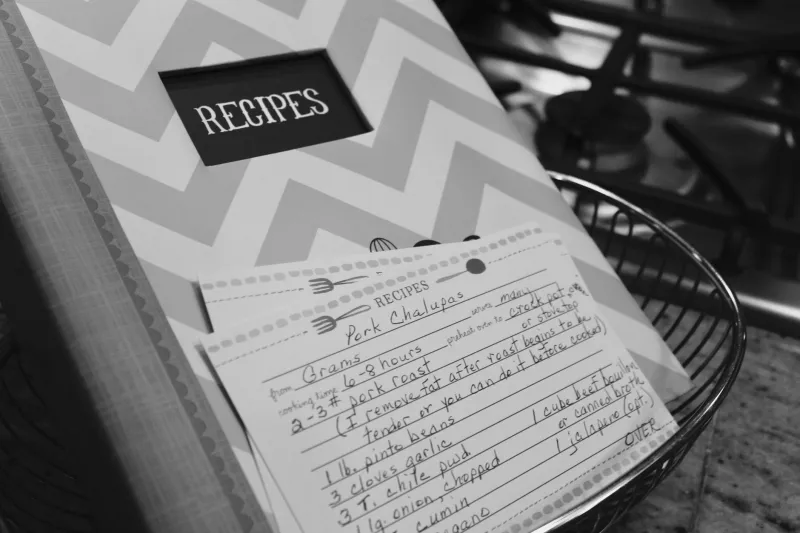
The estate sale was winding down — furniture gone, jewelry sorted, the good stuff long claimed — when a woman in Columbus, Ohio spotted a shoebox tucked under a folding table. Inside were roughly two hundred handwritten recipe cards, some going back to the 1930s, written in three different hands across three generations of the same family. Butter-stained. Flour-dusted. Annotated in pencil with notes like use less salt and Aunt Mabel hated this but everyone else loved it.
She bought the whole box for four dollars.
"Those cards told me more about how that family actually lived than anything else in that house," she said later. "The furniture was just furniture. The recipes were a diary."
More Than a Cooking Instruction
Food historians have long understood something that the general public mostly hasn't caught up to yet: what people cooked, and how they cooked it, is one of the most revealing records of everyday life that exists. More honest than diaries, which are written with an audience in mind. More specific than photographs, which show surfaces. A handwritten recipe card from 1943 doesn't just tell you how to make a molasses cake. It tells you what ingredients were available, what substitutions were necessary (lard for butter, powdered egg for fresh), what the family considered a treat, and often — in the margins and footnotes — something about the person who wrote it.
The cards that survive in estate sale shoeboxes are the unfiltered version of American food history. Cookbooks were aspirational. Recipe cards were real.
Professional food historians have worked with institutional archives — the collections held by universities, historical societies, and culinary schools — for decades. But the private, domestic record of how ordinary American families actually cooked has been largely scattered and unpreserved. It lives in those shoeboxes. And when those shoeboxes go unsold at estate sales, they often go directly to the trash.
What the Cards Actually Reveal
Spend enough time with a collection of mid-20th-century recipe cards and patterns start to emerge that published food histories often miss.
Regional specificity, for one. A recipe for "Depression Soup" from rural Mississippi looks nothing like one from a Polish-American household in Milwaukee, even if both were written in the same decade and driven by the same economic pressures. The ingredients, the technique, the flavor profile — all of it reflects the specific geography, immigrant heritage, and local supply chain of that particular kitchen. That granularity is almost impossible to reconstruct from published sources.
Substitution notes are particularly valuable to researchers. When a 1942 card says use Crisco if no butter — we haven't had real butter since March, that's a data point about wartime rationing that a government report could confirm but could never make feel real. The personal annotation does what the archive can't.
Then there are the recipe names themselves. Many dishes in private family collections have names that never appeared in any published cookbook — regional nicknames, family inventions, adaptations of immigrant recipes that evolved over generations into something entirely new. Some of these represent genuinely distinct regional cuisines that have no other surviving record.
The Collectors Racing Against the Clock
A loosely connected community of amateur collectors has emerged around this material, driven partly by nostalgia, partly by genuine historical interest, and partly by the urgency of knowing that the window is closing.
The generation whose grandmothers wrote these cards is aging. Estate sales are clearing out the last of the mid-century domestic archive at an accelerating pace. Every weekend, in church halls and suburban driveways across the country, boxes of handwritten cards are priced at a dollar and sometimes don't sell.
Collectors like the woman in Columbus have started showing up specifically to rescue them. Some focus on particular regions — Appalachian cooking, Gulf Coast Creole traditions, the German-Russian foodways of the Great Plains. Others collect thematically, hunting for Depression-era adaptation recipes or WWII rationing workarounds. A few are simply trying to save as much as possible before it disappears.
Digitization projects have begun to emerge, though they remain underfunded and fragmented. The crowd-sourced recipe archive at Feeding America's historical collections holds thousands of scanned cards. Independent projects on platforms like Google Drive and dedicated websites have assembled regional collections. The challenge is not just scanning the cards but transcribing the handwriting, contextualizing the ingredients, and tagging the content in ways that make the archive searchable and useful.
Several university food studies programs have begun taking donations of private recipe collections, though the infrastructure to process and preserve them properly remains limited.
Why This Matters Beyond Nostalgia
There's a preservation argument here that goes beyond sentiment. American regional food culture has been homogenizing steadily since the mid-20th century, accelerated by chain restaurants, standardized grocery supply chains, and the replacement of regional cooking traditions with national food media. Some of what's being lost is genuinely irreplaceable — techniques, flavor combinations, and ingredient uses that evolved over generations in specific communities and exist nowhere else in the written record.
The handwritten recipe card is one of the few places that record survived. A church cookbook from rural Louisiana in 1955 might contain the only written version of a particular Cajun preparation. A recipe tin from a Czech-American household in Nebraska might preserve a variation on a traditional dish that no longer exists in its country of origin.
Food writers and culinary historians argue that these cards deserve the same preservation urgency we give to other forms of folk art and material culture. The grease stains and pencil annotations aren't signs of lesser value. They're the evidence of actual use — proof that this was real life, not performance.
If you find yourself at an estate sale and spot a shoebox full of handwritten cards, the collectors would tell you the same thing: buy it. Four dollars is a fair price for someone's whole food life.