America's Floating Hotels: The Overnight Ferry Routes That Time Forgot
The Slow Boats That Beat Flying
While travelers queue at airport security and squeeze into middle seats, a secret network of overnight ferries glides across America's waters with private cabins, full-service restaurants, and panoramic views that change by the mile. These floating hotels represent the last remnant of an era when getting there was half the adventure—and they might just offer the best travel value in America.
Most Americans have forgotten these routes exist. The few who remember them assume they disappeared with the steamboat era. But scattered across the country's coastlines and Great Lakes, overnight ferries continue carrying passengers in comfort that would make airline executives weep with envy.
The Routes Time Forgot
The most spectacular survivor runs between Bar Harbor, Maine and Yarmouth, Nova Scotia. The CAT ferry transforms what would be a grueling 8-hour drive through multiple border crossings into a 3.5-hour cruise across the Gulf of Maine. Passengers can book private cabins with ocean views, dine on fresh lobster while watching whales breach in the distance, and arrive refreshed rather than road-weary.
Further south, the Cape May-Lewes Ferry connects New Jersey and Delaware across Delaware Bay. While technically a day route, the evening crossings offer something magical—dinner service as the sun sets over the water, transforming a simple transportation need into an event. The 85-minute crossing costs less than most airport parking fees.
The Great Lakes hide even better secrets. The SS Badger, America's last coal-fired passenger steamship, carries cars and passengers across Lake Michigan between Wisconsin and Michigan. The four-hour crossing includes staterooms, a movie theater, and deck space for watching one of the world's largest freshwater lakes roll by.
 Photo: SS Badger, via dxltb3n5j8l6j.cloudfront.net
Puget Sound's ferry system operates multiple overnight-capable routes, though most passengers treat them as commuter services. The route from Anacortes to Sidney, British Columbia, offers private cabins and transforms the mundane task of reaching Vancouver Island into a scenic cruise through the San Juan Islands.
 Photo: Puget Sound, via cdn.quotesgram.com
Why These Routes Survived
While most passenger ferry services succumbed to faster alternatives, the survivors share common advantages that airlines can't match. They connect points where flying requires multiple connections or lengthy drives to regional airports. They carry vehicles, eliminating car rental costs and logistics. Most importantly, they offer an experience rather than just transportation.
"People book cabins on our overnight crossings for the same reason they book cruise ships," explains Captain Maria Santos, who's worked Great Lakes ferries for fifteen years. "The journey becomes part of the vacation. You can't get that on a plane."
These routes also benefit from geography. Crossing large bodies of water by bridge isn't always feasible, and tunnels are prohibitively expensive. Ferries provide the only direct connection, giving them monopoly advantages that airlines lost decades ago to highway systems.
Cost structures favor ferries on shorter routes. While airlines need massive infrastructure and can't profitably serve small markets, ferries operate with lower overhead and can adjust capacity seasonally.
The Hidden Value Proposition
Compare the real costs: a typical domestic flight includes airport parking ($15-30/day), baggage fees ($30-60), overpriced airport food ($20-40), and the stress of security lines and delays. An overnight ferry cabin often costs less than the flight alone while including transportation, accommodation, and meals.
The time calculation also favors ferries once you factor in airport arrival requirements, security delays, and ground transportation on both ends. A 6-hour ferry crossing might take the same total time as a 2-hour flight when you include all the airport overhead.
For travelers with vehicles, ferries eliminate the need to research parking, navigate unfamiliar rental car procedures, or pack everything into airline-approved luggage. You simply drive aboard and drive off—your car becomes a mobile hotel room and storage unit.
The Experience Factor
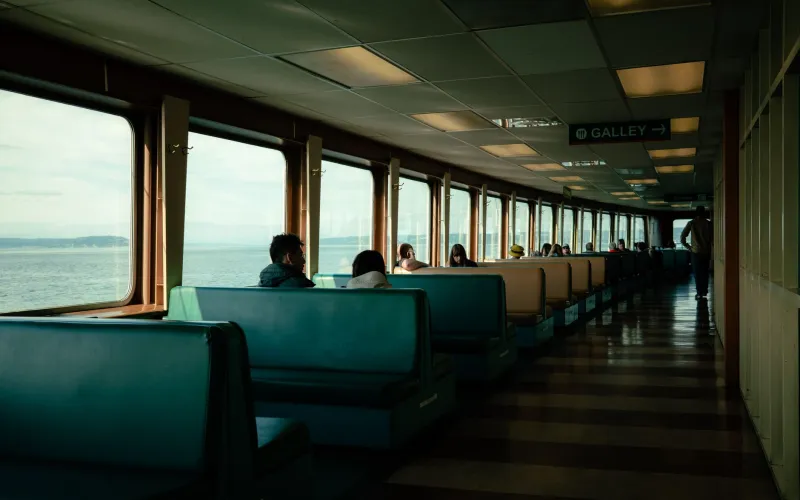
Overnight ferries offer amenities that airlines abandoned years ago. Private cabins with actual beds, not airline seats. Restaurants with real kitchens serving regional specialties. Deck space for watching wildlife, weather, and scenery change throughout the journey.
Many routes time their schedules around natural phenomena. The Bar Harbor-Yarmouth ferry often encounters whale pods during migration seasons. Great Lakes crossings showcase some of the world's most dramatic sunsets over vast freshwater horizons. Puget Sound routes thread between islands that would cost hundreds to visit by private boat.
The social aspect sets ferry travel apart. Shared spaces encourage conversation between travelers in ways that airplane seating actively prevents. Many passengers report making lasting connections during overnight crossings—something that rarely happens at 30,000 feet.
Booking the Forgotten Routes
Reservations for overnight ferry cabins require advance planning, especially during peak seasons. Most routes offer various accommodation levels, from basic berths to luxury suites with private balconies.
Timing matters enormously. Off-season crossings often cost half the summer rates while offering equally spectacular scenery. Weather can be more dramatic, but modern ferries handle rough conditions better than small aircraft.
Many routes offer package deals combining transportation with destination accommodations. These packages often cost less than booking components separately while ensuring coordination between ferry schedules and hotel availability.
Frequent travelers can find significant savings through seasonal passes or multi-trip discounts that airlines rarely offer anymore.
The Future of Slow Travel
As flying becomes increasingly unpleasant and expensive, overnight ferries represent a growing counter-trend toward "slow travel." Environmental concerns also favor ferries, which typically produce lower per-passenger carbon emissions than aircraft on comparable routes.
Several ferry operators report increasing bookings from younger travelers who view the journey as content for social media and an antidote to digital overload. The inability to maintain constant internet connectivity becomes a feature rather than a bug.
New routes are even being proposed. Entrepreneurs have studied potential ferry connections between coastal cities that currently require lengthy drives or expensive flights. The success of existing routes suggests Americans might be ready to rediscover travel by water.
Rediscovering America's Waterways
Overnight ferries prove that the best travel experiences often hide in plain sight. While everyone else fights for airline seats and pays premium prices for the privilege of being uncomfortable, a lucky few glide across America's waters in floating hotels that time forgot.
These routes offer something increasingly rare in modern travel—the luxury of time and space to actually enjoy the journey. In our rush to get everywhere faster, we've forgotten that sometimes the best way to travel is the one that lets us remember why we wanted to go in the first place.